
Blog
Agreed Value Insurance for Fine Art: How an Appraisal Sets the Number
An agreed value insurance appraisal fixes the dollar figure your insurer pays for a covered fine art claim before anything ever happens to the piece. This guide explains how the figure is set, why it beats actual cash value or unscheduled coverage for art, and how often to update it.
Fine art doesn't depreciate the way a car or a sofa does, and it doesn't always have a clean market comparable sitting on a shelf. That mismatch is exactly why agreed value insurance exists for collectors, galleries, and estates holding valuable pieces. An agreed value insurance appraisal for art sets a specific dollar figure for each scheduled piece before a loss ever happens, so there's nothing left to argue about when a claim comes in.
This post walks through what an agreed value policy actually is, how it differs from actual cash value and unscheduled homeowner's coverage, and how a professional appraisal builds the number that ends up on your policy schedule. We'll also cover how often that number needs to be refreshed.
What Is an Agreed Value Insurance Policy for Fine Art?
An agreed value policy is one where the insurer and the policyholder fix a specific dollar amount for each scheduled item at the time the policy is written, and that figure is what gets paid if a covered claim occurs. There's no depreciation deduction and no negotiation over what the piece was "really" worth at the moment of loss.
That fixed number doesn't come from a guess or a purchase receipt pulled out of a drawer. It comes from a documented appraisal performed before the policy takes effect. Standard homeowners scheduled personal property endorsements used across the industry state plainly that the amount listed on the schedule is agreed to be the value of the article, and that settlement runs on that agreed figure rather than a valuation argued after the loss. Once a piece is scheduled at an agreed value, the insurer has already committed to that number for a covered loss.
For collectors building a schedule of multiple works, or for a gallery insuring inventory, our art appraisal services for insurance coverage are built specifically to produce the documentation an underwriter needs to schedule a piece at an agreed value in the first place.
Agreed Value vs. Actual Cash Value vs. Unscheduled Coverage
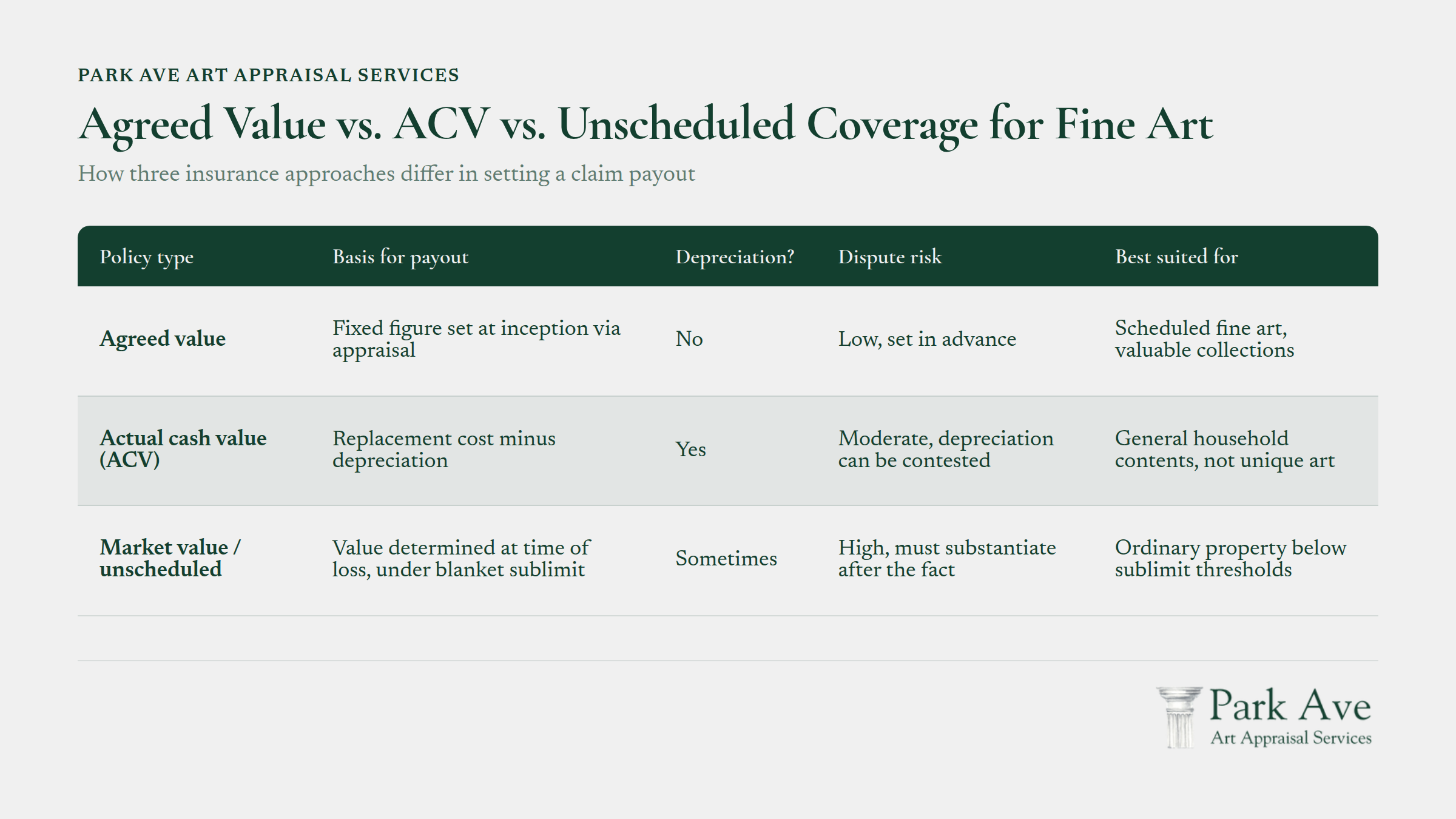
An agreed value policy pays the pre-set scheduled figure with no depreciation deduction, while actual cash value (ACV) and unscheduled homeowner's coverage leave the payout amount open to determination after the fact.
Actual cash value policies calculate a payout based on replacement cost minus depreciation, a formula built for furniture and appliances, not for a painting whose market value can rise well above what the owner originally paid. Unscheduled homeowner's coverage is worse for art specifically: most policies cap fine art and collectibles under a blanket sublimit, and the payout on a claim gets determined at the time of loss rather than agreed in advance. That means the policyholder is often left substantiating value after the piece is already gone or damaged, which is a hard position for anything unique and illiquid.
| Policy type | Basis for payout | Depreciation applied? | Dispute risk at claim time | Best suited for |
|---|---|---|---|---|
| Agreed value | Fixed figure set at inception from a professional appraisal | No | Low; figure is contractually set in advance | Individually scheduled fine art, valuable collections |
| Actual cash value (ACV) | Replacement cost minus depreciation | Yes | Moderate; depreciation calculation can be contested | General household contents, not unique art |
| Market value / unscheduled | Value determined at time of loss, often under a blanket sublimit | Sometimes | High; value must be substantiated after the fact | Ordinary personal property below sublimit thresholds |
Why Collectors, Galleries, and Estates Prefer Agreed Value Coverage
Art is uniquely hard to price after something has already happened to it, which is exactly why agreed value coverage exists for it. A painting isn't fungible: there's no identical replacement sitting on a dealer's shelf the way there is for a stove or a television. Values for a given artist's work can also swing significantly based on a recent auction result, a gallery show, or shifting critical attention, so "market value at the time of loss" is a moving target that both sides have every incentive to argue about.
A documented, pre-loss appraisal removes that ambiguity for everyone involved. The insurer knows the figure they're underwriting. The policyholder knows exactly what they'll recover. And if a claim does end up in front of an adjuster, there's a written record establishing that the piece existed, what condition it was in, and what it was worth, rather than a reconstruction attempted after the fact.
Key takeaway: For estates and galleries holding multiple works, agreed value coverage also simplifies portfolio management. Each piece has its own documented figure, so adding, removing, or adjusting coverage for one item doesn't require reopening the whole schedule.
How a Professional Appraisal Establishes the Agreed Value Figure
A USPAP-compliant appraisal establishes the agreed value figure through physical inspection, documentation of condition and provenance, and research into comparable sales, culminating in a written report with a stated effective date that the insurer uses to schedule the piece.
The appraiser physically examines the work rather than relying on a photograph or a prior sale price. That inspection documents condition (any restoration, damage, or wear), confirms authenticity and provenance where available, and notes anything that would affect value, such as a signature, inscription, or exhibition history. From there, the appraiser researches comparable sales: recent auction results for the same artist, gallery pricing for similar work, and the broader state of the market for that artist or category at the time of the appraisal.
The resulting report states a specific value as of a specific effective date, along with the reasoning and market data that support the figure. Insurers rely on that documentation to schedule the item and lock in the agreed value on the policy. Because the report will be read by an underwriter at the outset and potentially by a claims adjuster later, it needs to stand on its own: a reader who wasn't in the room during the inspection should still be able to follow how the number was reached.
Our appraisers hold credentials with organizations such as the ASA, ISA, and AAA, and every report is prepared in accordance with USPAP (Uniform Standards of Professional Appraisal Practice), the standard published by The Appraisal Foundation. For a single scheduled painting or work on paper, an insurance appraisal is quoted as a fixed fee, with pricing starting at $295 for standard reports and typically running $595 to $2,000 depending on the depth of research the assignment requires. Collections holding more pieces, thin documentation, or provenance that takes real digging to establish sit at the upper end of that range. Fees are quoted after we scope the assignment, and the engagement is always a fixed fee agreed before work begins, never billed hourly.
How Often Should You Reappraise Scheduled Fine Art?
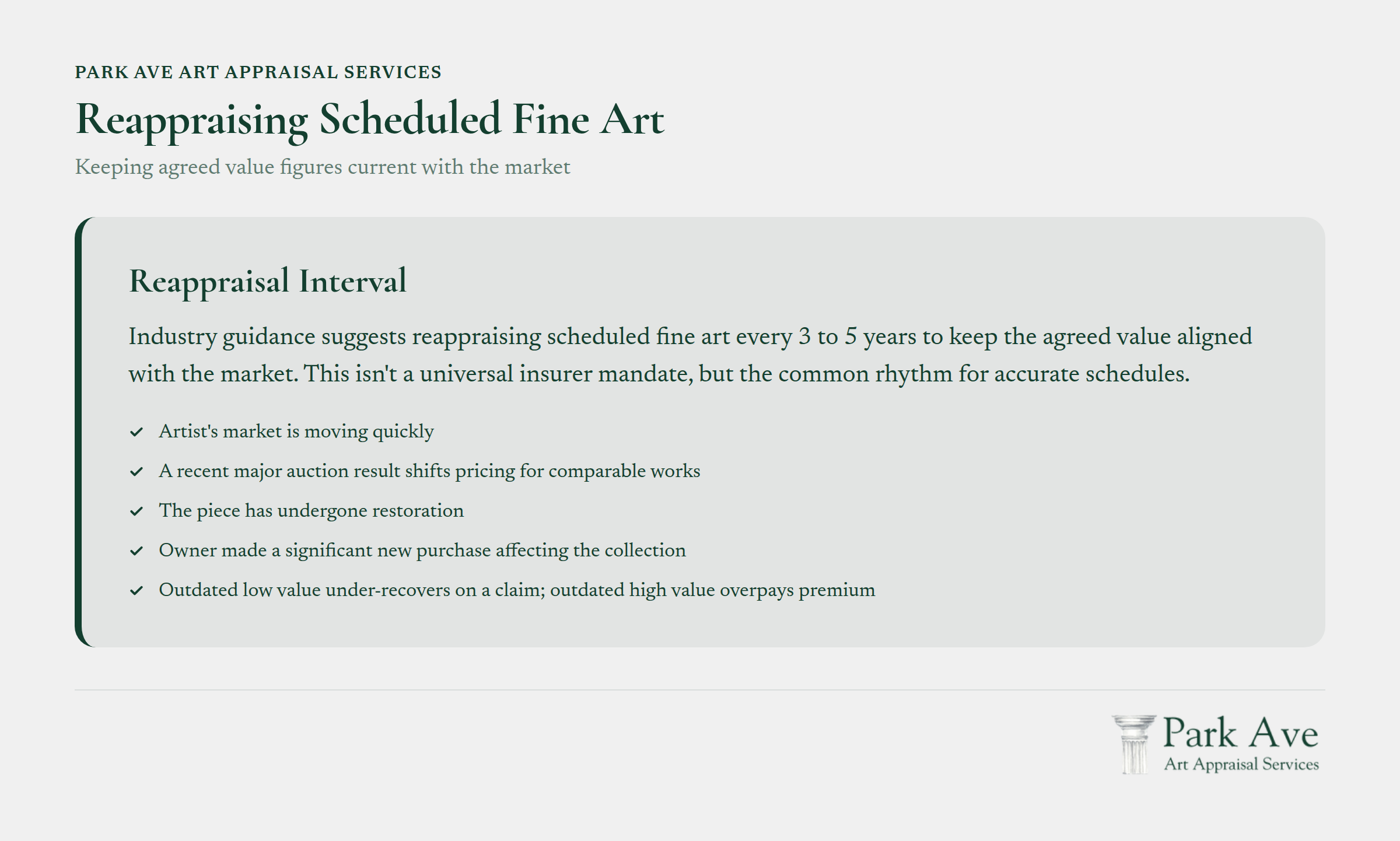
General industry guidance points to reappraising scheduled fine art every 3 to 5 years to keep the agreed value figure current with the market. That interval isn't a fixed insurer requirement in every policy, but it's the common rhythm across the industry for keeping a schedule accurate.
Some situations call for a sooner update. If an artist's market is moving quickly, a recent major auction result has shifted pricing expectations for comparable works, the piece has undergone restoration, or the owner has just made a significant new purchase that changes the overall collection, it makes sense to reappraise ahead of that 3 to 5 year mark rather than wait for the routine cycle. An agreed value figure that's badly out of date works against the policyholder either way: an outdated low figure under-recovers on a claim, and an outdated high figure means paying premium on more coverage than the piece is currently worth.
What Happens at Claim Time
Under an agreed value policy, a covered insurance claim is paid at the pre-agreed scheduled figure with no depreciation deduction and no dispute over what the piece was worth. The number was settled when the policy was written, and that's the number that gets paid.
Under actual cash value or unscheduled coverage, the policyholder is in a much harder spot. They may need to independently substantiate the piece's value after the loss has already occurred, often without the piece itself available to inspect, competing against a depreciation formula or a blanket sublimit that was never designed with a unique artwork in mind. For something as individual and illiquid as fine art, that's a slow and uncertain process at exactly the moment a collector needs clarity most.
Getting the Number Right Before You Need It
An agreed value insurance appraisal isn't paperwork you file away and forget. It's the document that determines whether a claim gets resolved cleanly or turns into a drawn-out argument over what a one-of-a-kind piece was worth. Getting a current, well-documented appraisal in place, and keeping it current as the market and the collection change, is the most direct way to make sure your coverage actually matches your art.
If you're scheduling a new acquisition, updating an existing policy, or simply due for a reappraisal, our team can prepare a USPAP-compliant art appraisal for insurance coverage built to give your insurer the documentation it needs to set an accurate agreed value. Request an appraisal and we'll scope the assignment and quote a fixed fee before any work begins.
This article is provided for general informational purposes only and does not constitute legal, tax, or financial advice. Readers should consult a qualified attorney, CPA, or insurance professional regarding their specific circumstances.