
Blog
Do You Need an Appraisal to Donate Art for a Tax Deduction?
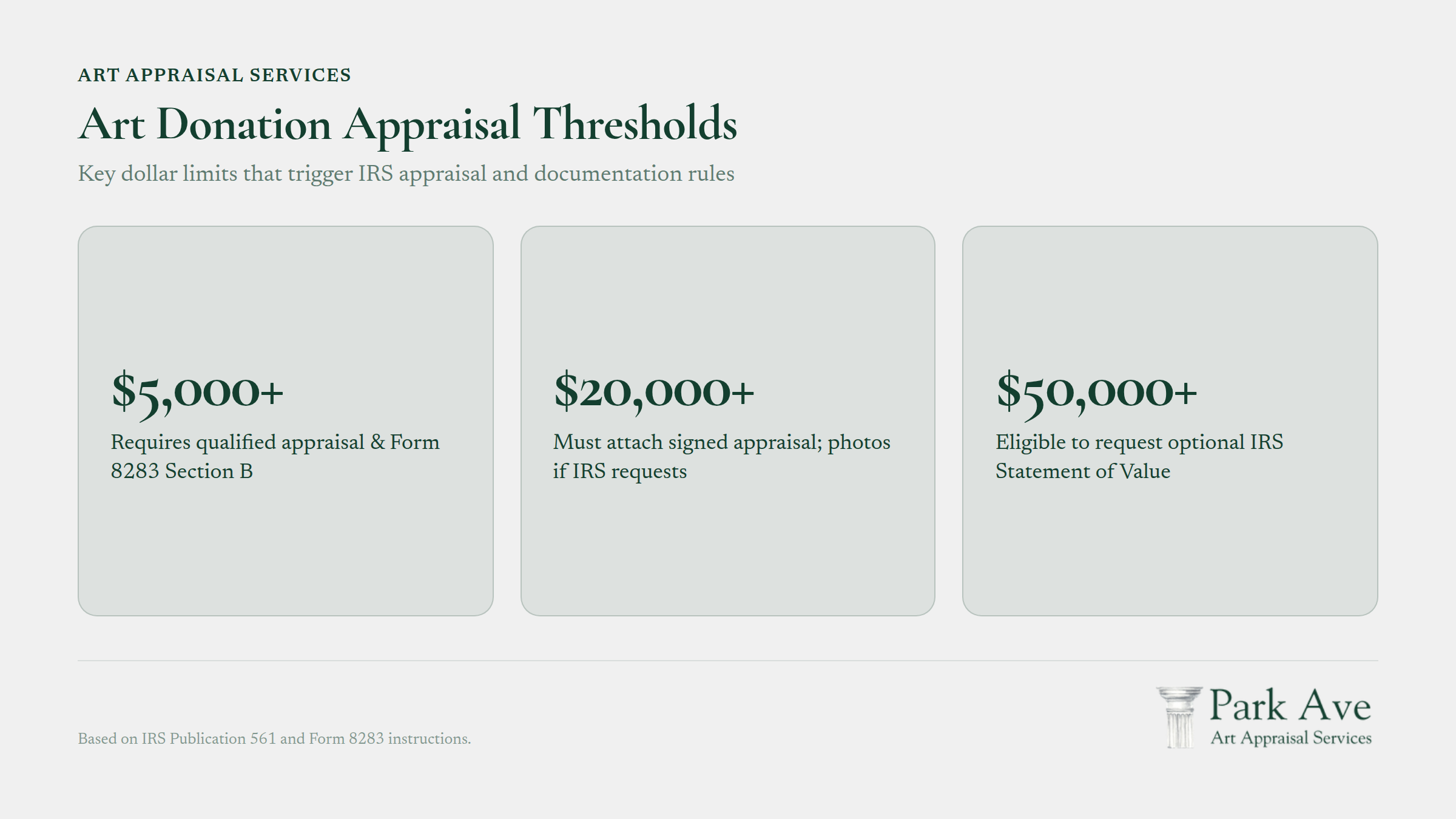
A qualified appraisal is required for any art donation where the claimed deduction exceeds $5,000, and additional rules kick in at $20,000 and $50,000. This guide breaks down the IRS thresholds, what makes an appraisal "qualified," and how missing paperwork can cost you the deduction entirely.
Donating art to a museum, university, or charitable foundation can be one of the more generous things a collector does, and one of the more heavily scrutinized on a tax return. The IRS does not simply take a donor's word for what a painting or sculpture is worth. Once the claimed deduction crosses certain dollar thresholds, the rules require a specific kind of appraisal, prepared by a specific kind of appraiser, submitted in a specific way. Get any part of that wrong and the deduction can be disallowed even if the artwork's value was never in dispute.
Our art appraisal service for charitable donations exists because of exactly this gap: collectors know they need documentation, but the thresholds, exceptions, and attachment rules are scattered across IRS instructions that were not written for a general audience. Here is what actually triggers the requirement, what the appraisal has to contain, and what happens when the paperwork falls short.
The $5,000 Threshold: When a Qualified Appraisal Becomes Mandatory
If you claim a deduction of more than $5,000 for a donated work of art, or for a group of similar art items given to one or more charities in the same year, you must support that deduction with a qualified appraisal and file Section B of Form 8283. This is not optional paperwork you can substitute with a receipt or a gallery invoice.
IRS Publication 561 states plainly that an income tax charitable contribution of art and collectibles claimed at more than $5,000 must be supported by both a qualified appraisal and a properly completed Form 8283. Below that figure, a donor still needs to substantiate the claimed value, but the law does not require a formal appraisal by a qualified appraiser.
The threshold applies per item or per group of similar items, not per charity. A donor who gives three prints by the same artist to three different museums in one tax year, each valued at $2,000, has to aggregate those gifts. The combined $6,000 crosses the line, and a qualified appraisal becomes mandatory for the group even though no single print exceeded $5,000 on its own.
What Counts as a Qualified Appraisal and Qualified Appraiser
A qualified appraisal is a report that meets specific content, timing, and independence standards set out in the Form 8283 instructions, not just any written opinion of value. A qualified appraiser is someone with verifiable education and experience valuing the type of property in question, who regularly performs appraisals for compensation, and who has no prohibited relationship to the donor or the donee that would compromise independence.
A compliant report generally includes:
- A detailed description of the artwork, including medium, dimensions, condition, and provenance where relevant
- The valuation effective date and the date the appraisal report was prepared
- The valuation method used and the specific evidence supporting the conclusion, such as comparable auction results or dealer records
- The appraiser's name, credentials, and a signed declaration meeting the requirements referenced in the Form 8283 instructions
- A statement confirming the fee was not based on a percentage of the appraised value
That last point matters more than it might seem. An appraisal fee tied to a percentage of the concluded value, or to the size of the resulting tax deduction, disqualifies the report outright under longstanding IRS rules. Our appraisers, along with credentialed professionals across the industry, follow fixed-fee engagement structures for exactly this reason. Fees for our artwork appraisal service start at $295 for standard reports and $395 for IRS-qualified reports, quoted as a fixed fee once we understand the scope of the assignment, never billed hourly and never tied to the value we conclude.
Appraisers working in this space typically hold credentials through organizations such as the ASA, ISA, or AAA, and prepare reports in accordance with USPAP (the Uniform Standards of Professional Appraisal Practice). No single appraiser carries every credential, and our team assigns the right specialist based on the medium and period of the work being valued.
Additional Requirements at $20,000 and $50,000
A signed copy of the appraisal must be attached to the return once the claimed deduction reaches $20,000. Below that level, the appraisal is kept in the donor's records but not filed with the return; at $20,000 and above, a complete, signed copy has to go in with the tax filing itself.
The Form 8283 instructions also note that a photograph of the object, of a size and quality that fully shows the piece, must be provided if the IRS requests one. For anything donated at this value level, it is worth having professional photography on hand before you ever need to produce it.
A separate, optional step becomes available once an item has been appraised at $50,000 or more. Donors at this level can request a Statement of Value from the IRS Art Appraisal Services unit before filing the return. This is a pre-filing review the IRS performs on request, and it can add a layer of confidence heading into a filing season, but it is not a substitute for the qualified appraisal itself. The appraisal still has to exist, still has to meet every content and independence requirement, and still has to accompany the return where required. The Statement of Value simply gives the donor an IRS-reviewed reference point before the return is submitted.
Donations Under $5,000: You Still Have to Support the Value
No, a qualified appraisal is not legally required when the claimed deduction for an item or group of similar items is $5,000 or less. That does not mean no documentation is needed. Donors giving property worth more than $500 must still file Form 8283, and the value claimed still has to be reasonably supportable if the IRS asks questions later.
The risk here is aggregation. A donor who gives five similar pieces to different charities across a single tax year, each priced individually under $5,000, still has to add up the total claimed value for that group of similar items. If the combined figure exceeds $5,000, the qualified appraisal requirement applies to the whole group, not just to any single piece. Collectors who donate incrementally throughout the year sometimes miss this and find out only when a return is questioned.
Can Similar Items Share One Appraisal?
Yes, in most cases. A donor giving a group of similar items to the same donee in the same tax year can generally cover the whole group with a single qualified appraisal, as long as that report includes the full required information for each item in the group individually, not just an aggregate figure. The exception runs the other direction: items collectively valued at $100 or less can be grouped by the appraiser with less individual detail, since the reporting burden at that value level is not worth the added documentation.
For most collectors donating a handful of related works, meaning several pieces by the same artist, from the same collection, or of a similar medium, one well-documented appraisal covering all of them is standard practice and keeps costs down compared to commissioning a separate report for every item.
What Happens if the Appraisal or Form 8283 Is Incomplete
An incomplete Form 8283 or a non-qualified appraisal is one of the most common reasons the IRS disallows a charitable art deduction on audit. The rules do not leave much room for partial compliance: the appraisal has to meet every substantive requirement, the form has to be properly signed by both the appraiser and, in Section B, an authorized representative of the donee organization, and the attachment rules at $20,000 have to be followed exactly.
An appraisal can also lose its qualified status after the fact if the donor withheld information from the appraiser or misrepresented facts about the property in a way that a reasonable person would expect to cause the appraiser to misstate its value. In other words, the appraiser's independence and the accuracy of what they were told both matter. A qualified appraisal built on incomplete or misleading information from the donor is not a qualified appraisal at all, regardless of how thorough the report looks on paper.
None of this means the IRS guarantees acceptance of any particular report, appraised value, or deduction; the agency reviews each filing on its own facts. What a properly prepared, USPAP-compliant appraisal does is give the return a defensible basis, prepared to meet the documentation standards the IRS itself has published.
Timing: When the Appraisal Has to Be Completed
The qualified appraisal must be received before the due date, including extensions, of the return on which the deduction is first claimed. If the deduction is instead first claimed on an amended return, the appraisal must be in hand before that amended return is filed.
This timing rule trips up donors who wait until the end of tax season to think about valuation. Because a qualified appraisal takes time (research into comparable sales, dealer records, and market conditions for the specific artist or medium isn't instant), donors planning a significant art gift should have an appraiser engaged well before the filing deadline, not after.
Getting the Documentation Right the First Time
The thresholds are specific, but the underlying principle is simple: the larger the claimed deduction, the more the IRS wants to see in writing, and the more precisely that writing has to follow the rules. A $3,000 donation needs a supportable value and a completed form. A $30,000 donation needs a signed, qualified appraisal attached to the return and photographs ready if requested. A $60,000 donation opens the door to a pre-filing Statement of Value on top of everything else.
Our appraisers prepare art donation appraisals to meet each of these thresholds, from Section B qualification at $5,000 through the attachment and photography requirements at $20,000 and beyond. If you're weighing whether a piece needs full IRS-qualified treatment or a simpler standard report, our guide on how to get artwork appraised walks through that decision before you commission anything.
This article is provided for general informational purposes only and does not constitute legal, tax, or financial advice. Readers should consult a qualified attorney or CPA regarding their specific circumstances.