
Blog
Fair Market Value vs Replacement Value: Which One Does Your Art Appraisal Need?
Fair market value and replacement value answer different questions, and using the wrong one can undervalue your insurance coverage or overstate a tax deduction. This guide maps each standard to its correct use, insurance, estate, donation, or sale, so you request the right appraisal the first time.
An art appraisal is only useful if it answers the right question. "What is this painting worth?" sounds like a single question, but an appraiser has to know worth for what purpose before picking up a pencil. The two most common answers, fair market value and replacement value, are built on different logic, pull from different markets, and are not interchangeable. Get the wrong one on your report and you could end up underinsured after a loss or in trouble with the IRS after a donation.
This guide breaks down what each standard means, which situations call for which one, and what goes wrong when the two get mixed up. If you're insuring a collection, our art appraisal services for insurance coverage are built around the replacement value standard discussed below. If you're planning a charitable gift, our art appraisal services for charitable donation are built around fair market value and IRS Form 8283 compliance.
What Is Fair Market Value in an Art Appraisal?
Fair market value is the price a work would sell for between a willing buyer and a willing seller, neither one under pressure to act, with both having reasonable knowledge of the relevant facts. That is the definition the IRS applies to donated property, and it is the backbone of most tax-related art valuations, as described in IRS Publication 561.
Fair market value is grounded in the sales-comparison approach: the appraiser researches actual sales of comparable works, usually at auction, and adjusts for differences in size, condition, subject matter, provenance, and market timing. The question being answered is not "what would it cost to buy a replacement" but "what would this specific object actually fetch if it changed hands today in an appropriate market."
Fair market value tends to run lower than replacement value for most fine art, because the comparison market (often auction) does not carry the dealer margins, commissions, and search costs built into a retail purchase.
What Is Replacement Value in an Art Appraisal?
Replacement value, sometimes called retail replacement value, estimates what it would cost to acquire a comparable work of similar artist, medium, size, quality, condition, and provenance within a reasonable amount of time, through the marketplace where the client would actually shop to replace it. If a client buys art through galleries and dealers rather than at auction, that retail market, not the auction market, is the correct reference point for the appraisal.
This is a cost-based standard rather than a sales-comparison standard. Industry guidance from organizations including the International Society of Appraisers and the American Society of Appraisers treats replacement value as inherently tied to where and how the specific client would need to shop, not to a generic national average. An appraiser may need to adjust for taxes, framing, crating, and transportation, and should state clearly in the report whether the final figure includes or excludes those costs.
Because retail acquisition carries dealer margins and the friction of locating a comparable piece on short notice, replacement value is frequently higher than fair market value for the same object.
Fair Market Value vs Replacement Value: A Side-by-Side Comparison
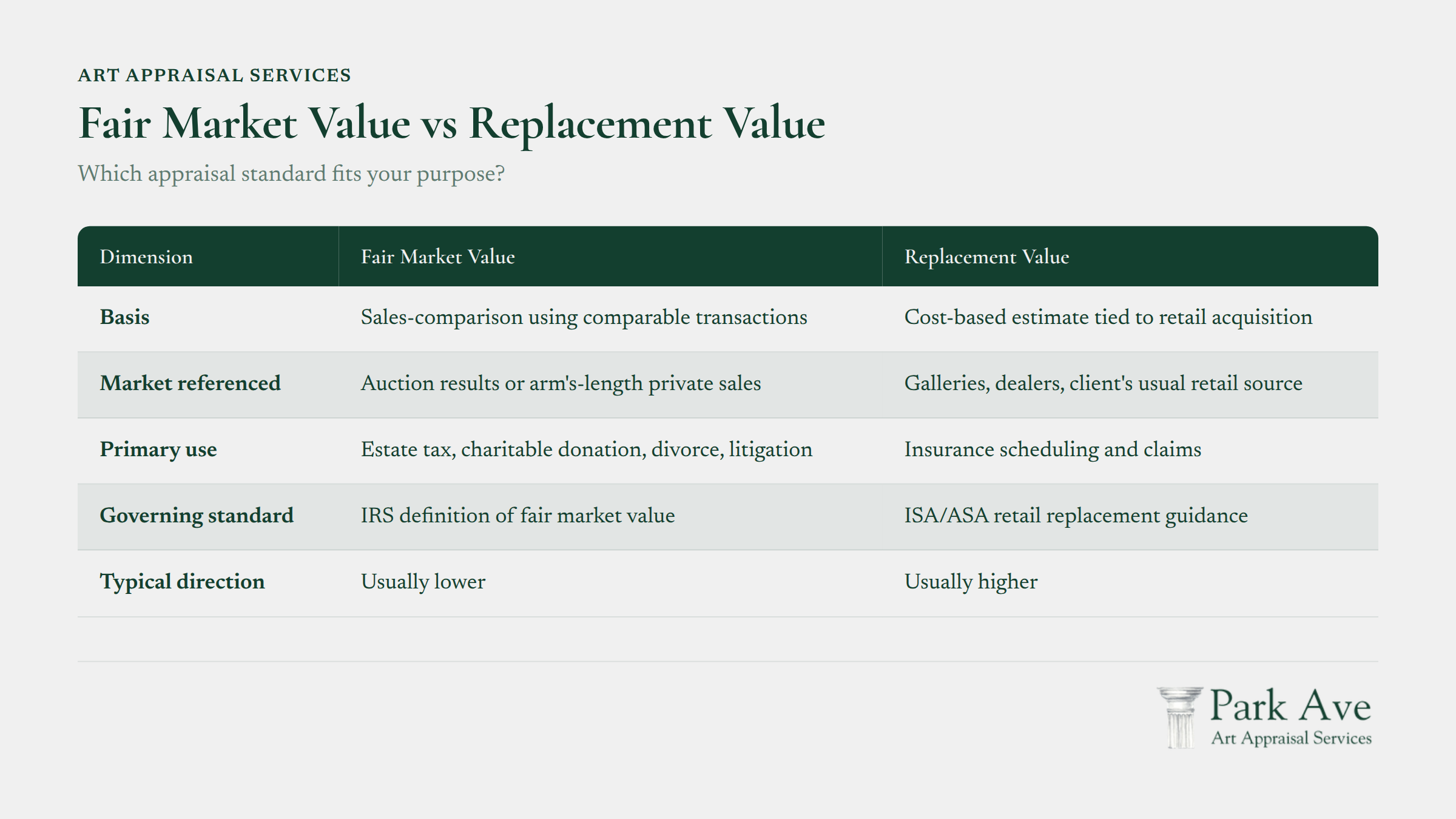
The table below lays out how the two standards differ across the questions that matter most in a real appraisal assignment.
| Fair Market Value | Replacement Value | |
|---|---|---|
| Basis | Sales-comparison approach using comparable transactions | Cost-based estimate tied to retail acquisition |
| Typical market referenced | Auction results or arm's-length private sales | Galleries, dealers, or the client's usual retail source |
| Primary use | Estate tax, charitable donation, divorce, litigation | Insurance scheduling and claims |
| Governing standard | IRS definition of fair market value | ISA/ASA retail replacement guidance |
| Typical direction vs. the other | Usually lower | Usually higher |
When Do You Need Fair Market Value?
Fair market value is the correct standard any time a government agency, court, or another party needs to know what the asset could actually sell for on the open market. Three situations come up most often:
- Charitable donation deductions. The IRS requires fair market value, not replacement value, to support a non-cash charitable contribution deduction.
- Estate and gift tax filings. Fair market value as of the date of death or gift establishes the reportable value for tax purposes.
- Divorce and equitable distribution. Courts dividing marital property want to know what an asset would realistically bring if sold, which is a fair market value question, not a cost-to-replace question.
A sale or purchase analysis, where a collector wants to understand realistic resale potential before listing a piece, also calls for fair market value rather than a retail replacement figure.
When Do You Need Replacement Value?
Replacement value is the correct standard whenever the purpose of the appraisal is insurance, whether that means setting coverage limits on a policy or supporting a claim after a fire, flood, theft, or damage in transit. The insurer needs to know what it would actually cost the policyholder to go out and acquire a comparable piece, not what the damaged or stolen piece would have brought at auction. If a client typically buys through a particular gallery or dealer network, the appraiser should anchor the valuation to that market, not to a lower-cost alternative the client would never actually use.
Pro tip: If you are insuring a collection you built through private dealers or galleries over many years, make sure your appraiser knows that before researching comparables. Defaulting to auction data for a replacement value assignment is a common shortcut that undervalues the report.
The $5,000 Threshold and Form 8283: What the IRS Requires
A charitable donation of art valued at more than $5,000 generally requires a qualified appraisal and a completed Section B of IRS Form 8283, prepared by a qualified appraiser and dated no earlier than 60 days before the contribution. Form 8283 itself is an appraisal summary attached to the tax return, not the appraisal report, and the underlying appraisal must still identify the valuation method and the specific comparable sales supporting the conclusion.
For donated art valued at $20,000 or more, the IRS instructions call for a complete copy of the appraisal to be attached to the return, and the agency may separately request a photograph of the work for its own review, a process handled by the IRS Office of Appeals Art Appraisal Services. None of this works if the appraisal was built on replacement value instead of fair market value; a retail-based figure is not a substitute for the fair market value standard the IRS requires to support a deduction.
Why Using the Wrong Value Type Is an Expensive Mistake
Mixing up the two standards is one of the most common, and most costly, errors in art appraisal. It runs in both directions.
Insuring at fair market value undervalues your coverage. If a policy is scheduled using a lower fair market value figure instead of retail replacement value, the payout after a loss will fall short of what it actually costs to acquire a comparable replacement. The gap shows up at the worst possible moment, right after a fire, flood, or theft, when the policyholder discovers the settlement check does not cover a real replacement.
Donating at replacement value overstates the deduction. A donor who submits a replacement-value figure on Form 8283 is claiming a deduction larger than the IRS definition of fair market value supports. That mismatch is exactly the kind of error that draws scrutiny, and it can result in a reduced or disallowed deduction along with penalties.
Watch out: A single appraisal report should not present one number as if it serves every purpose. If you need both an insurance figure and a donation figure for the same piece, the correct approach is two distinct value conclusions, each tied to its own intended use, not one number applied twice.
Requesting the Right Appraisal for Your Purpose
The starting point for any art appraisal is not the object, it is the reason you need the number. Tell your appraiser upfront whether the report is for insurance, an estate filing, a donation, a divorce proceeding, or a potential sale, and the correct value standard follows from there. Our team scopes every engagement around its intended use so the report holds up for the purpose it was built for, whether that means fair market value backed by comparable sales data or replacement value anchored to your actual retail marketplace. When you're ready, you can request an appraisal and tell us which situation applies; we'll confirm the correct value standard before any work begins.
This article is provided for general informational purposes only and does not constitute legal, tax, or financial advice. Readers should consult a qualified attorney or CPA regarding their specific circumstances.