
Blog
How Does Provenance Affect Art Value? What Ownership History and Authenticity Really Change
Provenance and authenticity don't just describe what a painting is; they change what an appraiser can defend that it's worth. Here's how documented ownership history, certificates of authenticity, and attribution language move fair market value up or down.
Two nearly identical paintings can walk into the same appraisal and come out with wildly different values, and the gap rarely has anything to do with brushwork. It comes down to paperwork: who owned the piece before you, whether a recognized expert has confirmed who painted it, and how confidently the appraiser can state that in a signed report. Understanding how provenance affects art value, and where authenticity fits into that picture, matters whether you're insuring a painting, filing an IRS-compliant appraisal for a charitable donation, or settling an estate.
What Provenance Means and Why It Substantiates Value
Provenance is the documented chain of ownership for an artwork, ideally traced back as close to the artist's studio as records allow. It matters because it helps establish what the object actually is before an appraiser ever gets to what it's worth.
A strong provenance file might include original invoices, gallery or dealer records, estate inventories, exhibition catalogues, and inclusion in a recognized catalogue raisonné (the definitive scholarly record of an artist's known works). Auction specialists weigh provenance alongside the artist, materials, rarity, and condition when they evaluate a piece, and they treat a documented ownership history as part of the authentication process itself, since it can establish a chain of custody extending back toward the date of creation, as Sotheby's has explained. A painting once owned by a notable collector, museum, or historically significant figure can command a premium precisely because that history reduces the buyer's risk that the work is stolen, looted, misattributed, or otherwise compromised.
Provenance isn't an automatic bonus, though. Its effect depends on how continuous, relevant, and verifiable it is. A single undated bill of sale from an unknown source does far less work than a documented chain running from the artist's estate through two or three reputable galleries.
If you've never had a piece through this process before, our step-by-step guide to getting artwork appraised walks through exactly what kind of paperwork to gather before an appraiser ever looks at the canvas.
Certificates of Authenticity Help, But They Are Not the Final Word
A certificate of authenticity can support an appraiser's opinion, but it should never be accepted at face value. Certificates of authenticity are among the most frequently forged documents in the collectibles world, and a certificate alone is only as reliable as the person or body that issued it.
A well-sourced certificate from a recognized foundation, catalogue raisonné committee, or subject-matter authority carries real weight. A certificate from an unnamed "expert" with no verifiable credentials or examination record carries almost none, no matter how official it looks. Appraisers are expected to scrutinize the source, the underlying examination, and whether the certificate's claims are consistent with the work's materials, condition, and known history, rather than treating the document as proof in itself.
Watch out: A glossy certificate in a frame is not a substitute for provenance. If the certificate can't be traced to a credible authority and cross-checked against the ownership record, it shouldn't move the appraised value on its own.
Authentication vs. Appraisal: Two Different Jobs
Authentication is an expert's opinion on whether a work is genuinely by the artist claimed. Appraisal is an opinion of value. They sound similar but they are performed by different people using different expertise, and confusing the two is one of the most common mistakes owners make.
Most appraisers are not authenticators. Confirming genuine authorship at an expert level typically requires deep, specialized familiarity with a single artist's body of work, materials, and technique, often built over a career studying that artist specifically. What an appraiser must do is exercise reasonable due diligence to determine when authentication is needed and, when it is, point the client toward the right resource: a catalogue raisonné, an artist's foundation, or a recognized subject-matter expert. For donated artwork, the IRS Form 8283 instructions reflect this same expectation, directing appraisers to use reasonable diligence in confirming authenticity and to document the basis for that conclusion in the report.
Appraisers who hold credentials from organizations such as ASA, ISA, and AAA are trained to recognize the line between the two roles and to know when a work's attribution needs outside expert review before a value opinion can be finalized in accordance with USPAP.
How Attribution Language Signals Certainty and Moves Value
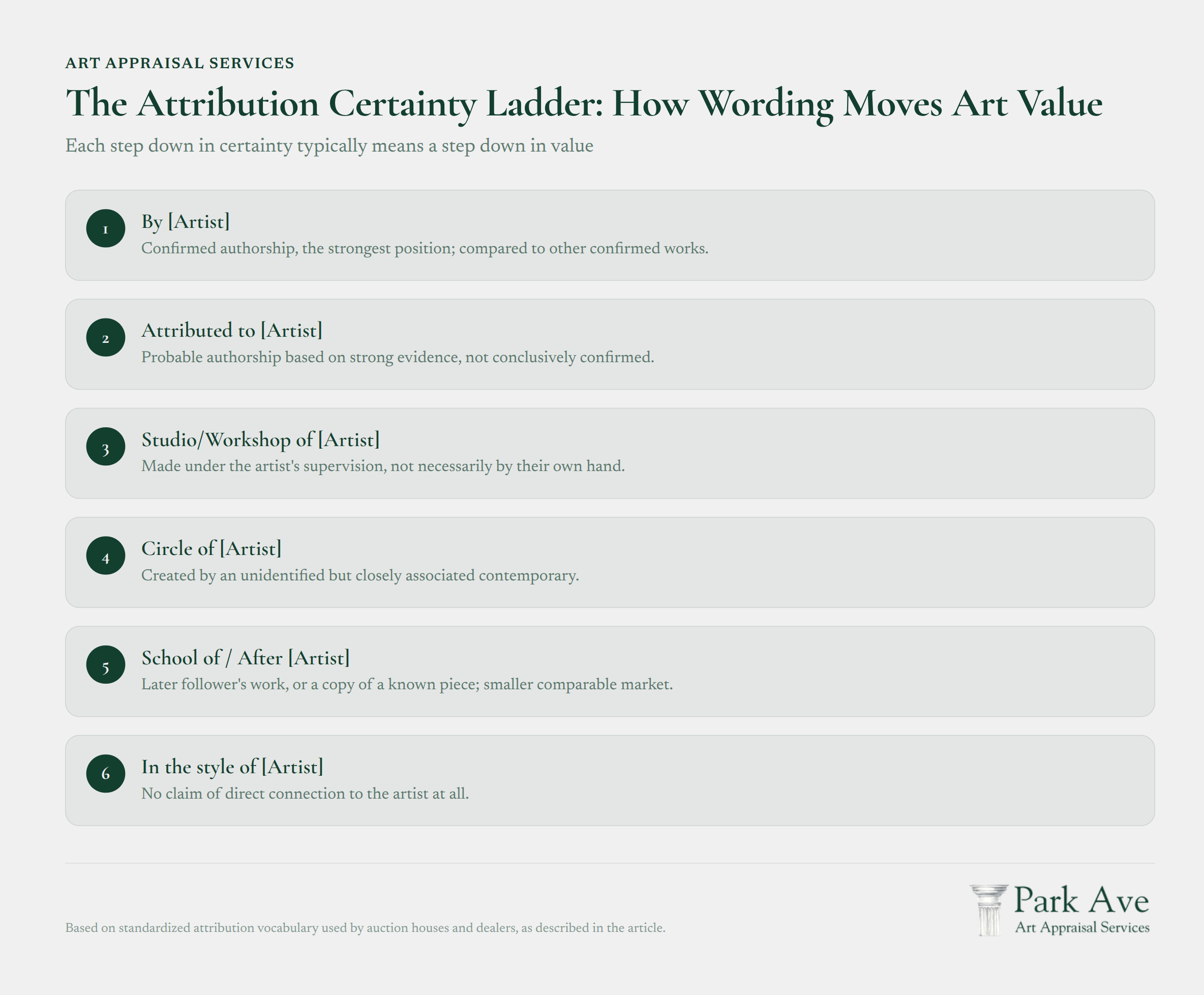
The specific wording an appraiser uses to describe authorship reflects a defined level of certainty, and that certainty directly moves the concluded value. Auction houses and dealers use a fairly standardized vocabulary for this, and a compliant appraisal report should define whichever terms it uses rather than leaving them ambiguous.
Roughly in order from most to least certain:
- "By [Artist]": Confirmed authorship, the strongest position a report can take.
- "Attributed to [Artist]": Probable authorship based on strong evidence, but not conclusively confirmed.
- "Studio of" or "Workshop of [Artist]": Produced under the artist's supervision, but not necessarily by the artist's own hand.
- "Circle of [Artist]": Created by an unidentified but closely associated contemporary.
- "School of [Artist]": Made by a follower, often in a later period, working in the artist's style.
- "After [Artist]": A copy of a known work, regardless of when it was made.
- "In the style of [Artist]": No claim of direct connection to the artist at all.
Each step down that ladder typically means a step down in value, sometimes a dramatic one, because it shifts the comparable sales an appraiser can reasonably use. A confirmed work is compared against other confirmed works by that artist. A "school of" piece has to be compared against other unattributed period pieces, a much smaller and generally less valuable market.
A Worked Example: Same Painting, Two Very Different Appraisals
The clearest way to see how provenance affects art value is to compare two versions of the same hypothetical painting: an oil landscape believed to be by a mid-20th-century artist with an established secondary market.
| Factor | Documented Provenance | Missing or Disputed Provenance |
|---|---|---|
| Ownership history | Continuous chain from the artist's studio through two prior gallery sales, with invoices | No records prior to the current owner's purchase in 2015 |
| Authentication status | Listed in the artist's catalogue raisonné | Not listed in any catalogue raisonné; attribution disputed |
| Attribution language used in the report | "By [Artist Name]" | "Attributed to [Artist Name]" |
| Comparable sales the appraiser can use | Recent auction results for confirmed, catalogued works by the artist | Sales of unattributed or "circle of" works from the same period |
| Appraised fair market value | Approximately $180,000 | Approximately $35,000 to $50,000 |
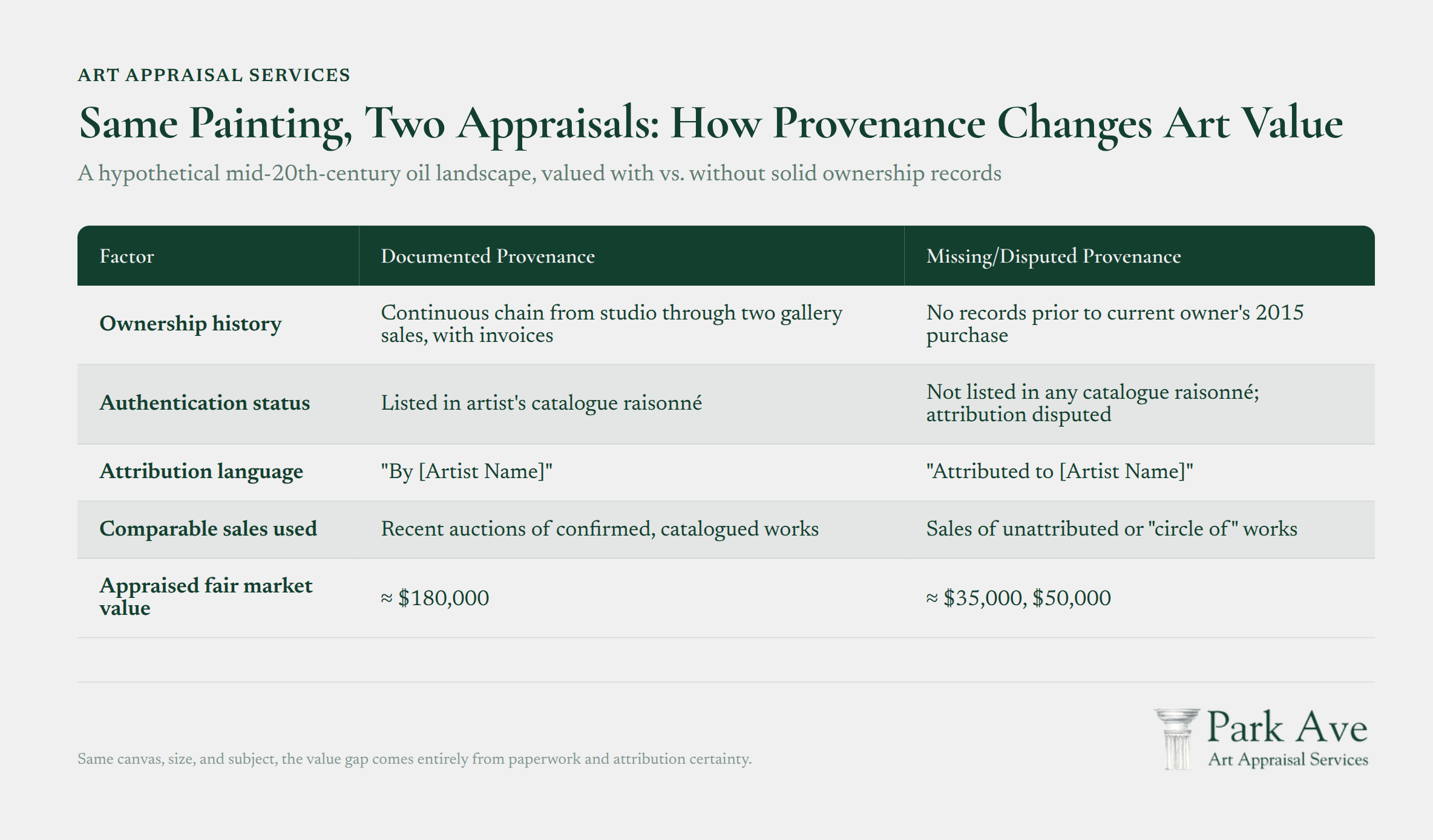
Same canvas, same size, same subject matter, and a difference of well over $100,000 driven entirely by paperwork and attribution certainty. That gap isn't an appraiser padding one number and shorting another; it reflects two genuinely different markets. A confirmed, catalogued work sells to buyers competing for a known artist's output. An unresolved attribution sells to a much smaller, more cautious pool of buyers willing to take on the risk.
What a Qualified Appraisal for a Donated Artwork Must Document
A qualified appraisal for a charitable art donation has to address the item's history, including provenance, and any authenticity documentation available, not just describe the piece and state a number. This is a substantive requirement, not paperwork for its own sake: appraisal guidance developed with input from organizations including the American Society of Appraisers directs appraisers to address ownership history and authentication as part of the value analysis itself, not as a separate afterthought (see guidance on IRS requirements for gifts and donations).
Fair market value itself is generally defined as the price a work would change hands for between a willing buyer and a willing seller, with neither under compulsion and both having reasonable knowledge of the relevant facts, as IRS Publication 561 explains. Provenance and authenticity are part of those "relevant facts." They change how a knowledgeable buyer perceives the object's risk and desirability, which is exactly why they move the number.
Documentation thresholds increase along with the claimed value:
- At $20,000 or more: A complete, signed copy of the qualified appraisal must be attached to the tax return, per the IRS Form 8283 instructions, along with a photograph adequate to identify the item.
- At $50,000 or more: The taxpayer may request a formal Statement of Value from the IRS before filing, a process built around submitting the qualified appraisal for review, as described in IRS guidance on the Statement of Value request procedure.
Watch out: Provenance and authenticity aren't the only variables that belong in a compliant report. Physical condition and any history of restoration have to be fully disclosed too. A landscape with a documented, ironclad ownership chain can still lose significant value if it has water damage, an overpainted section, or extensive inpainting that a buyer would need to know about.
Provenance Is Evidence, Not a Guarantee
A strong ownership history and a well-sourced authentication opinion give an appraiser something solid to build a value conclusion on. They don't override everything else. An appraiser still has to weigh condition, market timing, comparable sales, and the quality of the piece relative to the artist's other work. What provenance and authenticity do is determine which market the appraiser is even allowed to compare the piece against, and that single decision is usually what separates a strong number from a modest one.
If you're weighing a donation, an insurance policy, or an estate matter and the paperwork on a piece is thin, incomplete, or contradictory, that's worth sorting out before the appraisal, not after. Our team can walk through what documentation you already have and what's worth tracking down. Request an appraisal to get started.
This article is provided for general informational purposes only and does not constitute legal, tax, or financial advice. Readers should consult a qualified attorney or CPA regarding their specific circumstances.